Skills are not the new gamification

Two weeks immersed in the L&D world: Docebo's Inspire 2026, then Learning Technologies 2026 in London.
Across every track and keynote, one theme was inescapable: skills. Yes, "AI" was plastered across every vendor booth, but it was a buzzword in search of problems to solve. Everyone was offering AI content creation, and there are plenty of creepy AI avatar vendors. But underneath the noise, only a handful are trying to crack how AI actually drives outcomes.
My first reaction to skills: another hype cycle. Points, badges, leaderboards. We've seen this pattern before.
Then the inversion hit. The AI on the floor was flashy and feature-driven. The skills work in the sessions was digging into the heart of what enablement solves for. AI felt like a demo. Skills felt like a transformation. That's not a knock on AI, but the substance was in solving skills at scale.
Gamification's hangover
Skills entered the conversation carrying gamification's baggage. Gamification wasn't wrong. For most organizations, it was applied without objectives. People got excited by Duolingo and Salesforce Trailhead and wanted their own slice without doing the underlying work of aligning incentives to outcomes. Yu-kai Chou's Octalysis framework lays out the eight core drives behind real behavior change. Almost no LMS gamification module engages with any of it.
Skills programs are one bad design decision away from the same fate.
So when Docebo bought a small skills vendor, 365Talents, and announced plans to integrate them, my first reaction was: how cute, they're filling a product gap. Another vendor solution without vision. But that view inverted, first on Docebo's main stage, then in London, where fully dedicated tracks focused on skills. Something was up.
The turn
We'd been investigating how to reset skills and competencies at Snowflake, rethinking how to do skills entirely. There's no shortage of frameworks and tools. None of them quite fit.
Then Docebo's keynote changed my read. Instead of trotting out a complex framework of levels and methodologies, they framed everything around outcomes and argued that the skills layer matters only if it's connected to what's actually happening in the work. That's a different conversation than "let's standardize a taxonomy."
The picture sharpened in London. LT2026 had dedicated tracks for skills, with every block covering skills strategy, assessment, or implementation. The strongest session was Koreen Pagano's From Roles to Skills: What It Really Takes to Become a Skills-Based Organisation. She listed the historic places skills programs die: stuck on definitions, stuck on ontology frameworks, stuck on proficiency scales, stuck on technology-first approaches. Every one of those failure modes is a place where the work was too slow, too manual, or too brittle to keep up with how organizations actually change.
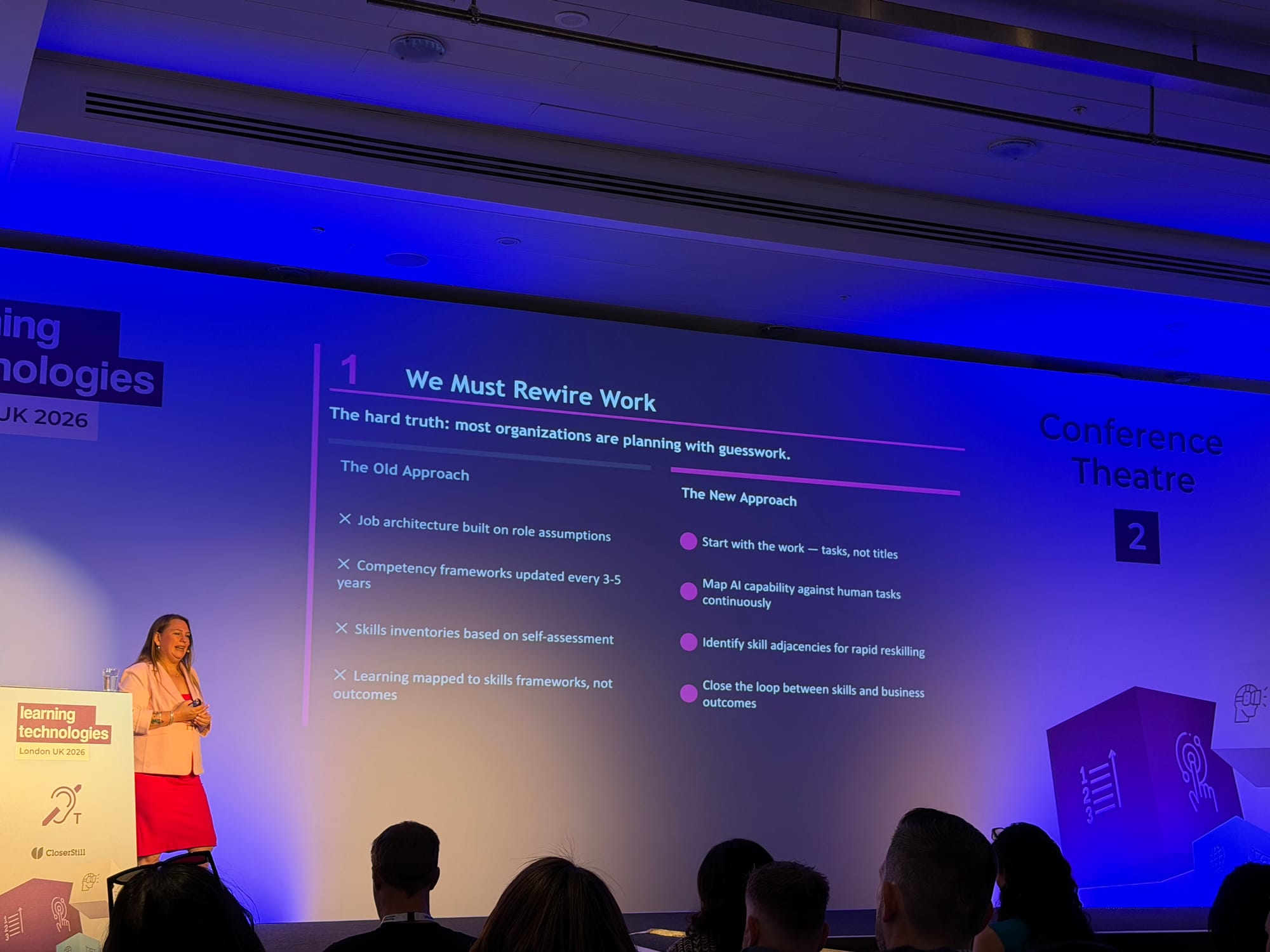
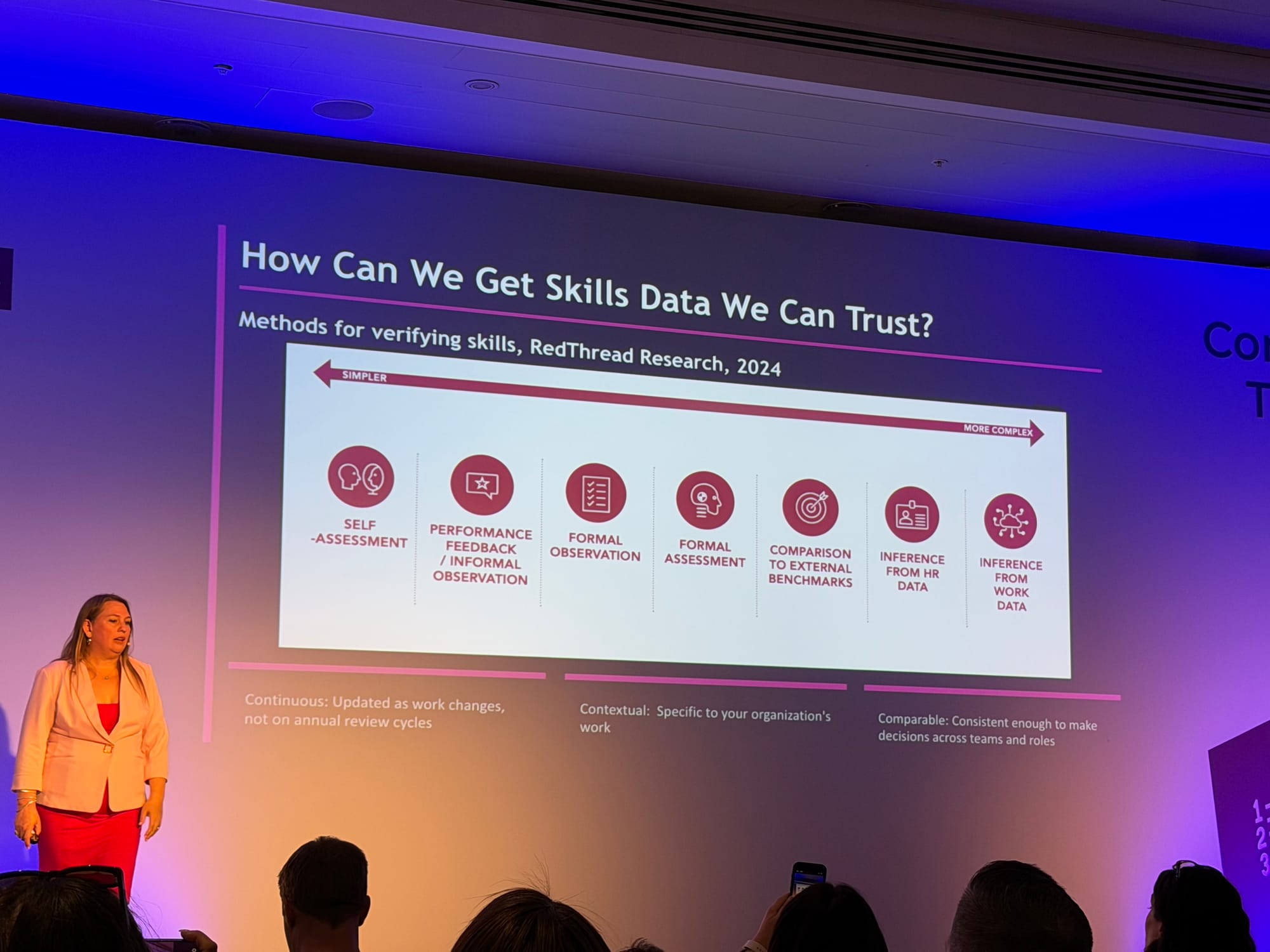
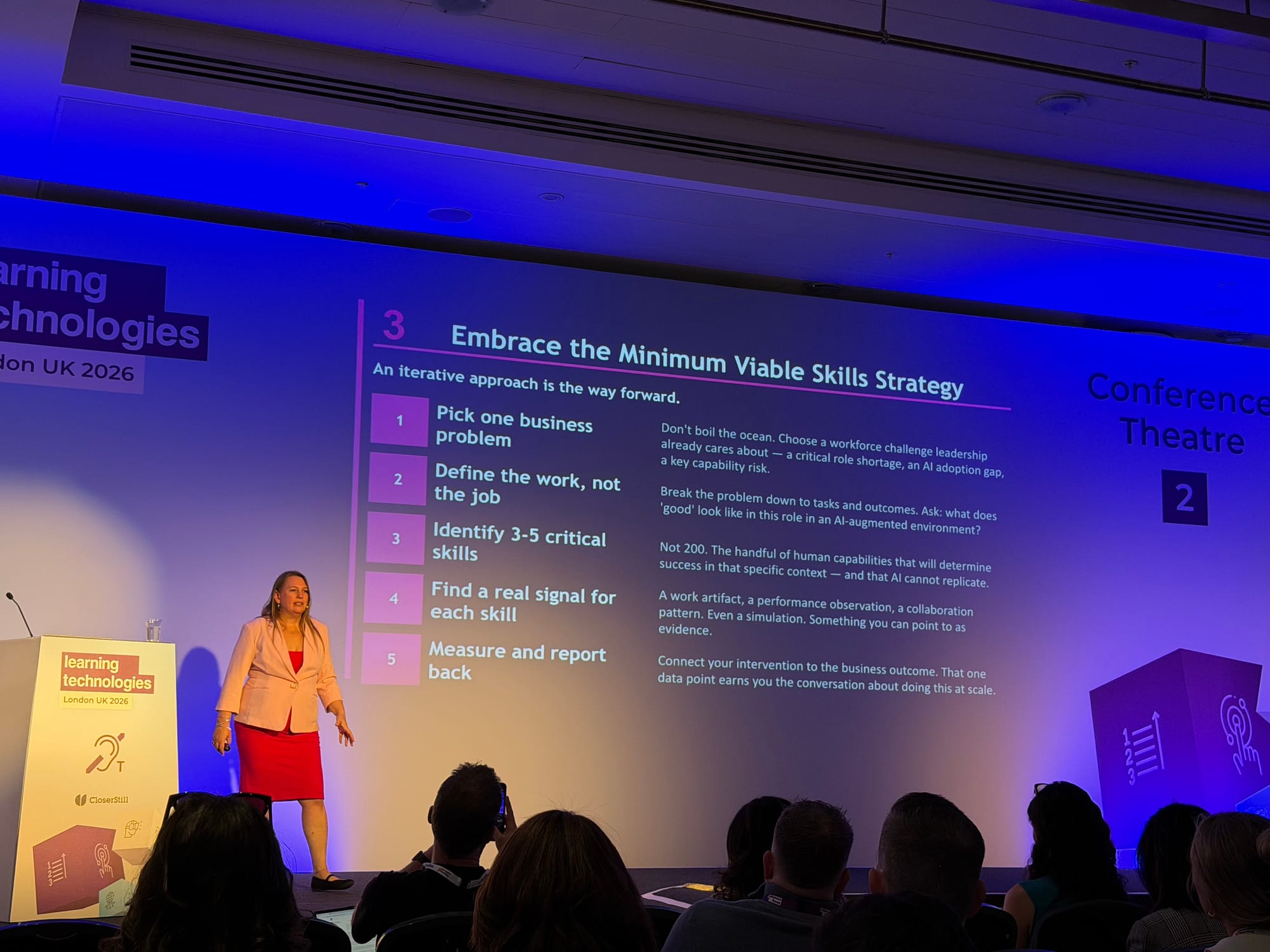
Select slides from Koreen Pagano's From Roles to Skills: What It Really Takes to Become a Skills-Based Organisation
What's different now is that AI lets you cut through all four. You don't need a perfect taxonomy if a system can infer skills from work product. You don't need a manual proficiency scale if you can pull signals from real performance. You don't need a six-month technology rollout if you can stand up a usable system in weeks. The historic blockers weren't conceptual. They were operational. AI dissolves the operational ones.
That reframes the whole thing. Skills aren't trying to be the new feature. They're trying to be the new substrate.
Why this is different
Gamification was a UI pattern. Or really, what should have been a psychological model of motivation that mostly got implemented as a UX layer on top of learning. Toggle it on, toggle it off. The underlying course was the same.
Skills are an organizing layer. They're the thing that lets you ask: do we have this capability? Where? At what depth? Building toward what? Are we delivering it through training, hiring, contracting, or AI?
You can't answer any of those questions with badges and certifications. Those are signals of what someone has already done, not what their current capabilities are today.
What the demos skip
Skills don't work in isolation. They connect a knowledge layer (product docs, GTM strategy, sales collateral, tooling) to a signals layer (call transcripts, CRM, product usage, customer data, the work itself). Without those two, a skills system is just another static taxonomy on the LMS. Never updated. Never connected to outcomes.
The value isn't in the layers themselves. It's in the interplay. When a CRM signal shows a customer interested in a specific use case but the rep never positions the relevant product, you can dig in: has the rep done the training, the roleplay, the validation? When someone joins with deep product knowledge from a prior role, why make them sit through the 101? Skills are how you meet people where they are, accelerate the work, and stay aligned to outcomes.
The data was sobering. Deloitte: 90% of organizations are moving toward skills-based models, but only 1 in 5 have operationalized them beyond traditional job descriptions. Most are saying the right things without rewiring anything, and that's where this could still go sideways. That version of "skills" really will be gamification 2.0.
Fosway adds the technical layer. 74% of L&D leaders say their current LMS doesn't meet their AI expectations, even as live AI capabilities in learning systems doubled (11% to 26%) in a single year. That 74% isn't an indictment of skills as a concept. It's an indictment of stacks that can't connect skills to knowledge to signals to outcomes.
The vendors with answers weren't on the main stage presenting their solutions. They were in the booth conversations, talking about agentic content systems, knowledge layers feeding AI tutors, signal pipelines from Gong and Salesforce, learner profiles that update from behavior instead of from self-assessment. The vendor capabilities are clear. The architecture and execution gaps are wide open.
The year ahead
Skills aren't the new gamification. They're a new learning object.
Instead of tracking completions and advancements solely through learning, we have an opportunity to measure real-world behavior as a skill, and use training and AI-powered roleplays to fill in the knowledge and skill gaps.
If you're an enablement or L&D leader, this is the theme of your year. The vendors won't hand it to you. The frameworks won't get you there. Three things to take with you:
- AI is part of the workforce now. Build, Buy, Borrow, Bot. The Red Thread research's 4B model captures it: AI is a labor option alongside humans. Someone (or something) has to decide who does which work, and skills are how that decision gets made. The superpower: pair skills data with real-world signals and do what wasn't possible before. Two prerequisites. Your content has to be retrievable, not packaged inside courses. Your systems have to capture signals (or AI can pull them from systems you already have, like Gong).
- Pick outcomes, not roles. Skills only matter when they're tied to objectives. Pick the outcomes that count, map the skills behind them, and build for those, not for the org chart. Done right, your team's skills data tells you what the org can actually do and what gaps to close. Done wrong, it's a taxonomy that decorates the LMS.
- Dig in. We're in uncharted territory. Plenty of opportunity, plenty of dead ends. Pilot small. Connect tight. One team, one outcome, one feedback loop. The orgs that win this cycle won't be the ones with the cleanest taxonomy. They'll be the ones connecting skills to the rest of their stack while everyone else is still admiring the framework.
Gamification rewarded completions. Skills measure work.
This is part one of a series on what I took away from Learning Technologies 2026. Next up: AI's noise vs. AI's signal, and what "AI that actually drives outcomes" looks like in practice.